It’s Saturday. We’ve been here in Antakya for a few days now, but I still haven’t gotten used to this suffocating, humid heat, this constant wind that feels like it’s coming from a freshly opened oven. It’s Saturday, and Carol, “our boss,” has come to visit us. It’s nice to know she’s here with us for a few days!
It’s Saturday, and it’s our day off—finally, a bit of rest, some time to process and reflect on all the emotions we’ve experienced this past week. If there’s one thing I’m starting to understand, it’s that what we’re doing, the people we’re meeting while working at the refugee camp, will change my life. That much is certain. But when? When will I have the time to truly grasp what’s happening to me, how much God is changing me through this incredible adventure?
It’s on Saturdays that I have time to think—and not think. Time to do things without having to do anything. It’s on Saturdays that I truly enjoy this incredible part of the world. And today is a special Saturday because Carol is here, which means our whole team is finally together! And what better way to celebrate than by going out to dinner together? What better way to take advantage of the endless varieties of kebab that Turkey has to offer?
It’s around 6 p.m. when we leave the base where we’re staying in Antakya and head to the bus stop. We’ve heard that some lines have recently been restored after last year’s earthquake, so we figure—why not try? We’d love to go downtown and find a small local restaurant, a place where we can experience all the scents and flavors of this part of Turkey.
Subscribe to support me
We arrive at the bus stop, and honestly, we have no idea which bus to take. There’s a man waiting with us, so I gather my courage and ask for directions in English. He looks at me for a few seconds—I can’t tell if he understood me. Maybe he doesn’t speak English. Then he pulls out his phone, opens Google Translate, and types something in Turkish. Miracle! Now I can read what he wants to say in English. Thank God for Google Translate!
But maybe this time, Google Translate hasn’t worked properly. The text says: The center of Antakya no longer exists. I pause, confused. He types again and then turns his phone toward me once more: The earthquake destroyed everything.
A few seconds of awkward silence hold me back from speaking. Then the bus arrives. The man signals that this is the one going toward the center. We get on with him, not really knowing what to do or where to go.
I pull out my phone, open Google Translate, and ask for his name. Yilmaz, he tells me. The bus starts moving. I type again: Where can we find a restaurant near the center for dinner tonight? He gestures toward a restaurant that quickly passes by the window. I don’t catch it. He types again: These are the closest restaurants you’ll find to the center. Then he repeats: There is no center anymore. The earthquake destroyed everything.
I can’t believe what he’s saying. We knew the earthquake had caused massive destruction, but until this moment, I hadn’t fully realized what that really meant. The bus keeps going, and my team looks at me, waiting for an answer—waiting for me to tell them where we’re going to have dinner.
I turn back to Yilmaz and ask for a recommendation. He looks at me silently, not typing, as if time has stopped. I don’t understand. Then he finally speaks: You can come to my house for dinner!
I look at my wife, then at the rest of the team—there are five of us in total. I hesitate. Do I tell them that a stranger we just met at the bus stop has invited us to his home for dinner? I breathe in. I think. I breathe again.
There’s a voice inside me saying, It’s okay. But my eyes see our team—four women and me. My mind argues, No, it’s not okay. It’s too risky. The voice inside repeats, It’s okay.
Finally, I speak. I turn to Carol and say, We’ve been invited to dinner!
We all exchange glances, searching for reassurance, for an answer. Yilmaz asks again, Dinner? In my house?
We don’t know why, but we know it will be a yes. We know something incredible is happening. I turn back to Yilmaz and say, Okay. Dinner at your house!
The bus stops. Destruction. Ruins. A hill covered in nothing. Yilmaz gestures for us to follow him. We walk in silence until we reach the top of the hill—houses, more houses. He leads us up a staircase. On the second floor, at the doorway, stands Rasa, his wife, waiting to welcome us.
We step inside. The air smells of smoke. The walls are yellowed and cracked. Two couches, an armchair, a giant TV. Yilmaz gestures for us to sit.
We talk and talk and talk—thank you again, Google Translate. Time passes.
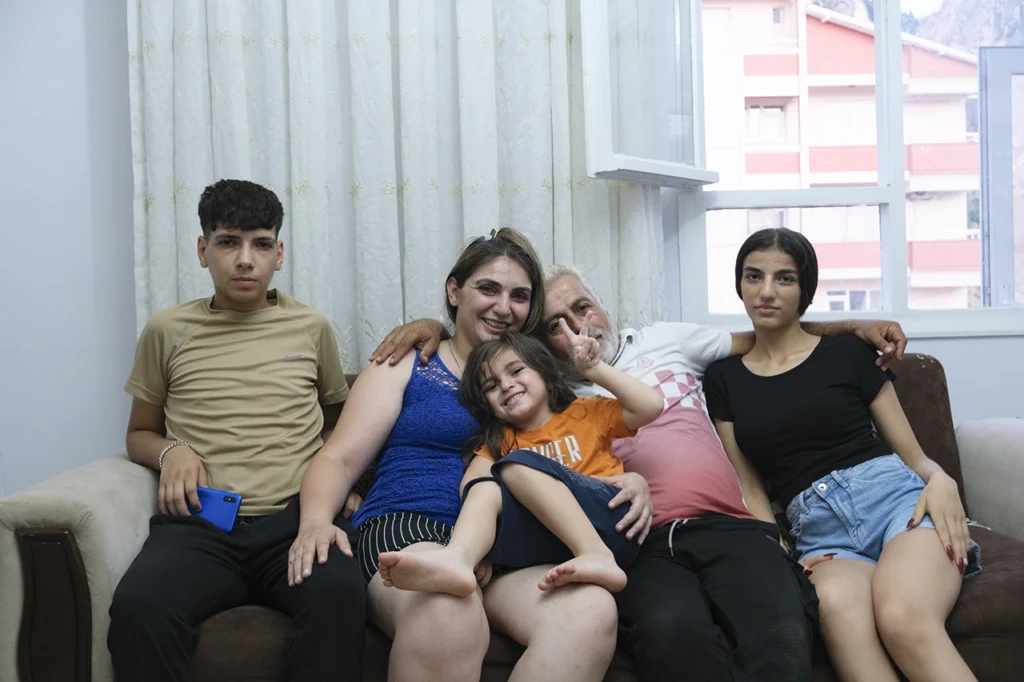
I want to take a photo for Yilmaz, a photo that will remind them—and us—of this incredible day. So Yilmaz, Rasa, and two of their children sit on the couch. The lighting is terrible; it’s practically dark outside. I do my best to take a “nice family photo” on their living room couch. CLICK. I look at the display of my Fuji and don’t know what to do. It’s not quite what I had hoped for.
I had imagined a beautiful studio portrait that would do justice to the beauty of this family—a family that opened their home to five complete strangers. A photo with the right lighting, maybe in black and white. But it’s not always possible to take the picture you envision. Sometimes, you just have to take the shot and decide what it is that gives it value. The perfect composition? The perfect light? The perfect expression on every face?
If that were the case, then I’ve taken a terrible photo. But there’s something in it—something real, something unique. There’s a story I recognize. There’s embarrassment, a little shyness, spontaneity, truth.
A noise distracts me—it’s my stomach, making its presence known. We’re hungry! Yilmaz makes a phone call, and shortly after, food is on the table.
It’s really happening. We’re in the home of a complete stranger, in an unfamiliar place, sharing food, time, stories, love.
There are no words to fully explain the sacredness of this experience. But that imperfect photo, flawed in a thousand ways, helps tell the story.
A single photo can’t always capture an entire story in detail. Nor can words alone, no matter how many. But an imperfect photo, accompanied by imperfect words, can add all the truth that’s needed—all the power of seeing, the strength of imagining. The power to transport whoever looks at it thousands of kilometers away, to Yilmaz’s home in Antakya, where the 2023 earthquake destroyed everything—but not the heart and resilience of the people who continue to fight to live, who keep loving, sharing—often what they don’t even have—through a hospitality I had never witnessed before.
Thank you, Yilmaz. Thank you, Rasa!